
Costs and pricing
Part of Cost per lead benchmarks UK: what businesses pay by sector
Cost per lead benchmarks UK: what businesses pay by sector
UK cost per lead benchmarks by sector, with typical accepted lead ranges for conveyancing, mortgages and B2B software, plus named sources and quote checks.
What to take away
- UK cost per lead depends on sector, lead definition, exclusivity and data route.
- Typical accepted exclusive lead prices run from about £50 in mortgages to £400 in B2B software.
- Shared leads can cost a third of exclusive prices, so compare like with like.
- Use the sector ranges as a starting point, then replace them with your own closed-sale data.
UK sector cost per lead benchmarks
| Sector | Typical shared lead | Typical exclusive lead | Common route |
|---|---|---|---|
| Conveyancing | £25 to £60 | £80 to £200 | Comparison sites and panel brokers |
| Personal injury | £50 to £150 | £150 to £500 | Paid search and panel brokers |
| Mortgages and protection | £20 to £50 | £50 to £120 | Comparison sites and broker networks |
| Accountancy and bookkeeping | £30 to £70 | £70 to £150 | Google Ads and local SEO |
| Education and training | £25 to £80 | £80 to £200 | Google Ads and Meta Ads |
| Home improvements | £20 to £70 | £70 to £250 | Checkatrade, MyBuilder and Rated People |
| B2B software and services | £60 to £200 | £150 to £400 | LinkedIn Ads and Google Ads |
These are accepted lead ranges, not raw enquiries. Shared leads are sold to several firms. Exclusive leads go to one buyer. Ask for the definition in writing before you compare two quotes. For regulated credit and mortgage leads, the FCA's Consumer Duty sits with the authorised firm, not the seller.
UK Cost Per Lead by Sector
Sector
- Conveyancing
- £25–£75 shared
- Personal injury
- £80–£350 per qualified claim
- Mortgages
- £30–£80 exclusive
- Accountancy
- £40–£150 per qualified enquiry
- Education and training
- £15–£50 per learner
- Home improvements
- £20–£60 boiler
- B2B software
- £60–£250 per MQL
Typical UK cost per lead
- Conveyancing
- Reallymoving, Simplify
- Personal injury
- National Accident Helpline, Claims Direct
- Mortgages
- MoneySuperMarket, Compare the Market
- Accountancy
- Unbiased, Bark
- Education and training
- Find a Course, Bark
- Home improvements
- Rated People, Checkatrade, Leads 2 Trade
- B2B software
- LinkedIn Ads, Cognism, Apollo.io
Named sellers
- Conveyancing
- How many firms receive each quote
- Personal injury
- FCA claims management authorisation
- Mortgages
- Evidence of affordability checks
- Accountancy
- Charged per enquiry or per appointment
- Education and training
- Refund terms if a learner is ineligible
- Home improvements
- Postcode limits and repeat-quote checks
- B2B software
- How firmographic filters are verified
What to check
- Conveyancing
- Personal injury
- Mortgages
- Accountancy
- Education and training
- Home improvements
- B2B software
Named UK lead sources and price models
Bark uses pay-per-lead credits. Professionals buy credits to contact clients, which suits trades and personal services.
MyBuilder is a pay-per-lead marketplace for home improvement jobs. Prices vary by trade, location and job value.
Rated People sells leads by trade and postcode. Buyers can set preferences and budgets before they buy.
Checkatrade charges trades a monthly membership fee. It suits trades that want a public profile and reviews.
MoneySuperMarket and Compare the Market charge providers per click or accepted application. They suit mortgages, insurance and credit.
Google Ads and Meta Ads run auctions. Your CPL depends on keyword competition, audience and landing page quality.
LinkedIn Ads targets job title and company size. It often produces higher B2B software CPLs than search.
The way fees are structured across B2B marketplaces follows the same logic, as our guide to B2B lead marketplace fees sets out.
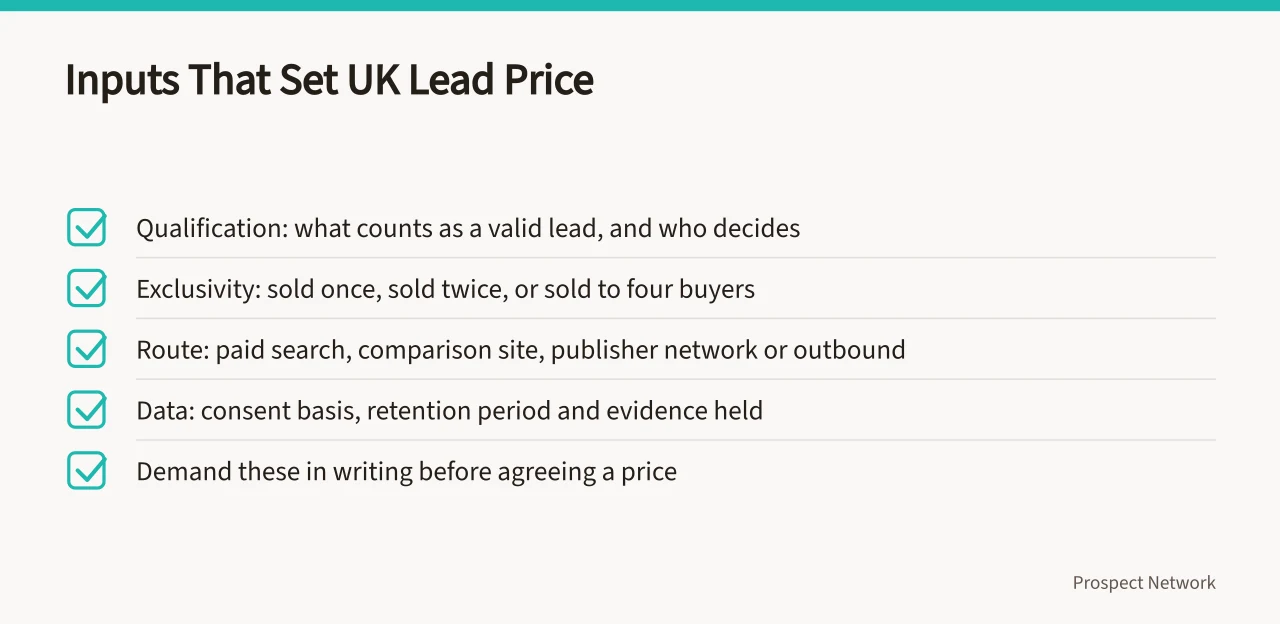
What sets the price inside a sector
- Qualificationwhat counts as a valid lead, and who decides.
- Exclusivitysold once, sold twice, or sold to four buyers.
- Routepaid search, comparison site, publisher network or outbound.
- Dataconsent basis, retention period and evidence held.
Demand these in writing: a £30 shared lead is not the same product as a £90 exclusive lead.
UK data rules also change what a seller can lawfully pass over. Consent and legitimate interests are separate lawful bases in the UK GDPR, and the ICO's direct marketing guidance says what a usable consent record looks like.
A worked example with labelled pound figures
The figures below are illustrative assumptions, not market data.
- 100 exclusive mortgage leads a month at £45 each£4,500.
- Ten in 100 become full applications.
- Four of those ten complete.
Cost per completed case: £4,500 divided by four, which is £1,125. If your average procuration fee is £600, the channel loses money before staff time is counted. Run the same arithmetic with your own conversion rate. A supplier's conversion figure is a sales claim, not evidence.
Where quality checks change the price
Cheap leads fail in ways that cost more later: duplicated records, wrong postcodes, customers who never enquired. Our checklist on spotting low-quality leads is a practical filter before you scale spend.
Rejections matter as much as price. A supplier at £50 per accepted lead beats one at £35 per raw lead if a third of the raw leads bounce. Put a rejection window and a credit mechanism in the contract before the first invoice.
Setting a working benchmark from your own data
- Pull twelve months of lead volumes, accepted leads and closed sales from your own CRM.
- Divide total channel cost, including staff time, by closed sales to get your cost per acquisition.
- Compare that figure with your average sale value and target margin.
- Set a ceiling price per lead and a minimum acceptance rate, then test one supplier at a time.
- Review monthly and retire any source that misses the acceptance rate twice in a row.
Common questions
What is a typical cost per lead in the UK?
Typical accepted exclusive leads run from £50 to £120 in mortgages, £80 to £200 in conveyancing and £150 to £400 in B2B software. Shared leads can be cheaper, but they are sold to several firms.
Why do UK figures differ from US ones?
The drivers differ more than the totals: auction competition, wage costs and consent rules all move prices. A US average cannot be applied to a UK campaign without rebuilding the assumptions.
How should I compare quotes from lead generation companies?
Ask for the same fields from each: lead definition, exclusivity, rejection window, credit terms and data route. Compare cost per accepted lead and cost per closed sale rather than the headline price.
Can I use industry averages to set a budget?
Use them as a starting range, then replace them with your own conversion data within a quarter. A benchmark you cannot trace back to a source is not a benchmark.