
Costs and pricing
Part of B2B lead marketplace fees: how to read a UK quote
B2B lead marketplace fees: how to read a UK quote
B2B lead marketplace fees in a UK quote: the three fee models, an illustrative invoice worked to cost per accepted lead, the hidden charges and six questions.
What to take away
- UK B2B lead marketplaces quote three structures: cost per lead, a monthly subscription with an allowance, and a success fee on closed business.
- The headline rate is rarely the deciding number. Credit expiry, exclusivity and return rules move the effective cost further.
- Compare every quote as a cost per accepted lead, net of VAT, at the volume you expect to buy.
- Ask for the return window in writing. A fourteen day window and a 48 hour window are different products at the same price.
How UK B2B marketplaces structure their fees
Cost per lead is the standard unit. You pay a fixed price for each record that matches an agreed definition, and the platform keeps the gap between what it pays the publisher and what it charges you. The same arithmetic applies whether the lead arrives by form, call or chat. The definition of cost per lead explains the underlying model.
A subscription buys access rather than volume. You pay monthly for a seat, a listing or an allowance of credits. Unused credits usually expire at month end, so the fee behaves as a floor rather than a cap.
A success fee sits at the other end of the risk. Performance-based advertising covers the model: the marketplace takes a percentage of contract value, or a fixed sum, once the deal closes. That shifts close-rate risk to the seller and raises the cost of each won deal.
A worked example with pound figures
The figures below are an illustrative rate card, not any one platform's prices; what matters is the method. A managed IT services firm in Manchester buys 200 leads in one month. The rate card is £450 a month including 10 credits, then £28 per credit, one credit per lead, with returns credited inside 48 hours.
Worked Example: Real Cost Per Lead
- £28headline rate per lead
- £28.93cost per accepted lead, ex VAT
- £34.72cost per accepted lead, inc VAT
- £6,319.20total paid including VAT
| Line | Basis | Amount |
|---|---|---|
| Monthly subscription | Includes 10 credits | £450 |
| Extra credits | 190 at £28 | £5,320 |
| Returned leads | 18 at £28 credited | -£504 |
| Net lead spend, ex VAT | £5,266 | |
| VAT at 20% | £1,053.20 | |
| Total paid | £6,319.20 | |
| Accepted leads | 200 bought, 18 returned | 182 |
| Cost per accepted lead | Excluding VAT | £28.93 |
| Cost per accepted lead | Including VAT | £34.72 |
The headline rate was £28. The invoice came to £28.93 per accepted lead before VAT and £34.72 after it. The gap comes from the subscription floor, the return credit and the tax line.
Subscription floors and minimum spend
Minimum monthly spend is the clause that catches buyers whose volume falls. A platform may set a monthly floor, £1,500 in an illustrative quote, that you pay whether you take the leads or not.
Some contracts run twelve months with 90 days' notice, turning a trial into an annual commitment. Others price per seat, so a five-person sales team pays five times for the same inventory. Our note on comparing lead network pricing models sets out how to put a unit rate, a whole-life cost and dispute rights side by side.
Read the notice period as closely as the rate. A rate you can leave in 30 days beats a 10% discount you cannot.
The charges that sit outside the headline fee
These are the lines buyers miss most often:
- Credit expiry at month end, which converts paid leads into lost spend.
- An exclusivity uplift, quoted as a multiple of the shared-lead price.
- Verification or phone-check fees charged on each accepted record.
- One-off or annual fees for CRM connectors and data feeds.
- Admin charges on returns, and a cap on how many leads you may return.
Contactability matters as much as condition. The rules are the Privacy and Electronic Communications Regulations (PECR), which sit alongside the Data Protection Act and the UK GDPR and cover marketing calls, texts and emails. The Information Commissioner's Office (ICO) enforces them, and its guidance on direct marketing explains when consent is needed. A record you cannot lawfully contact has no value at any fee.
Comparing two quotes on one sheet
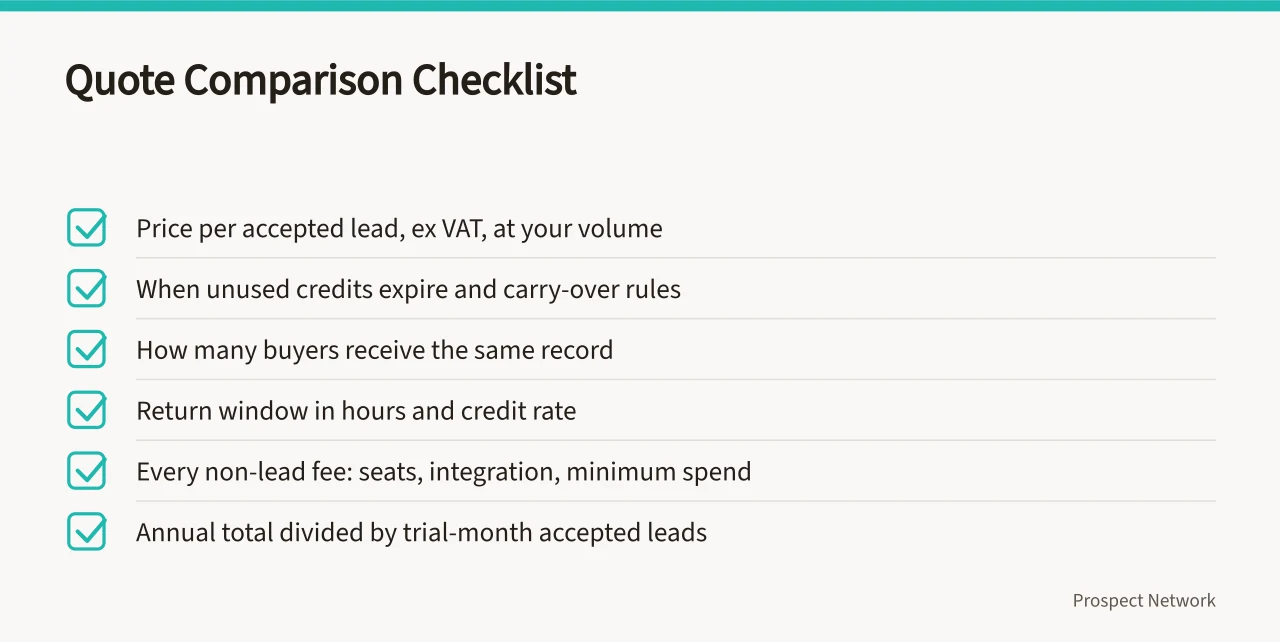
- Ask for the price per accepted lead, excluding VAT, at your expected monthly volume.
- Ask when unused credits expire, and whether they carry over.
- Ask how many buyers receive the same record, and in what order.
- Ask for the return window in hours and the credit rate on a return.
- List every non-lead feeseats, integration, listing and minimum spend.
- Divide the annual total by the accepted leads from a trial month.
Published ranges help you sanity-check the answer. Our cost per lead benchmarks by sector set out what buyers report paying across professional services and trades.
Common questions
Do UK lead platforms charge VAT?
Yes, where the supplier is VAT registered and the leads are standard-rated. Most VAT registered buyers reclaim it, but the cash leaves the account first.
Can I get a credit for a poor-quality lead?
On the contract terms, not on how you feel about the lead. Most platforms credit a record that fails a stated test, such as a disconnected number, inside a fixed window.
Is cost per lead cheaper than a subscription?
Only at low or unpredictable volume. A subscription wins when you consume the whole allowance every month and negotiate the overage rate down.
What minimum spend should I expect?
It is set platform by platform, so there is no national figure to quote; the £1,500 above is illustrative. Ask each platform for its own floor in writing, with the notice period beside it.