

Measurement
Lead network measurement that preserves the state ledger
Lead generation network measurement needs state-level definitions, reproducible queries, privacy-safe reporting, uncertainty and causal restraint.
Lead generation networks measurement should begin with the service state and decision, not a fashionable rate. A report becomes useful when another analyst can reproduce its population, numerator, denominator and exclusions, then see what action follows an unexpected result.
This England-facing guide uses UK analytical and regulatory sources. Research closed on 5 September 2026. It supplies no benchmark, conversion rate, lead value, sample result or causal effect. Blank fields are intentional and must be populated from authorised organisational evidence.
What to take away
- Preserve event times for every state instead of overwriting records with their latest label.
- Write a metric contract covering population, numerator, denominator, exclusions and query version before calculating ratios.
- Show data quality warnings above performance tiles on every dashboard.
- Keep descriptive monitoring, rule-based attribution and causal evaluation in separate reporting layers.
- Measurement quality cannot authorise collection, sharing or contact; separate reviewers decide those.
Preserve the state ledger
Do not overwrite a record with its latest label. Keep event times for submitted, quarantined, validated, matched, disclosed, accepted, rejected, credited, contacted, fulfilled, complained, suppressed and exited states. One enquiry can be accepted commercially but suppressed for later marketing, or credited for billing while a privacy investigation remains open.
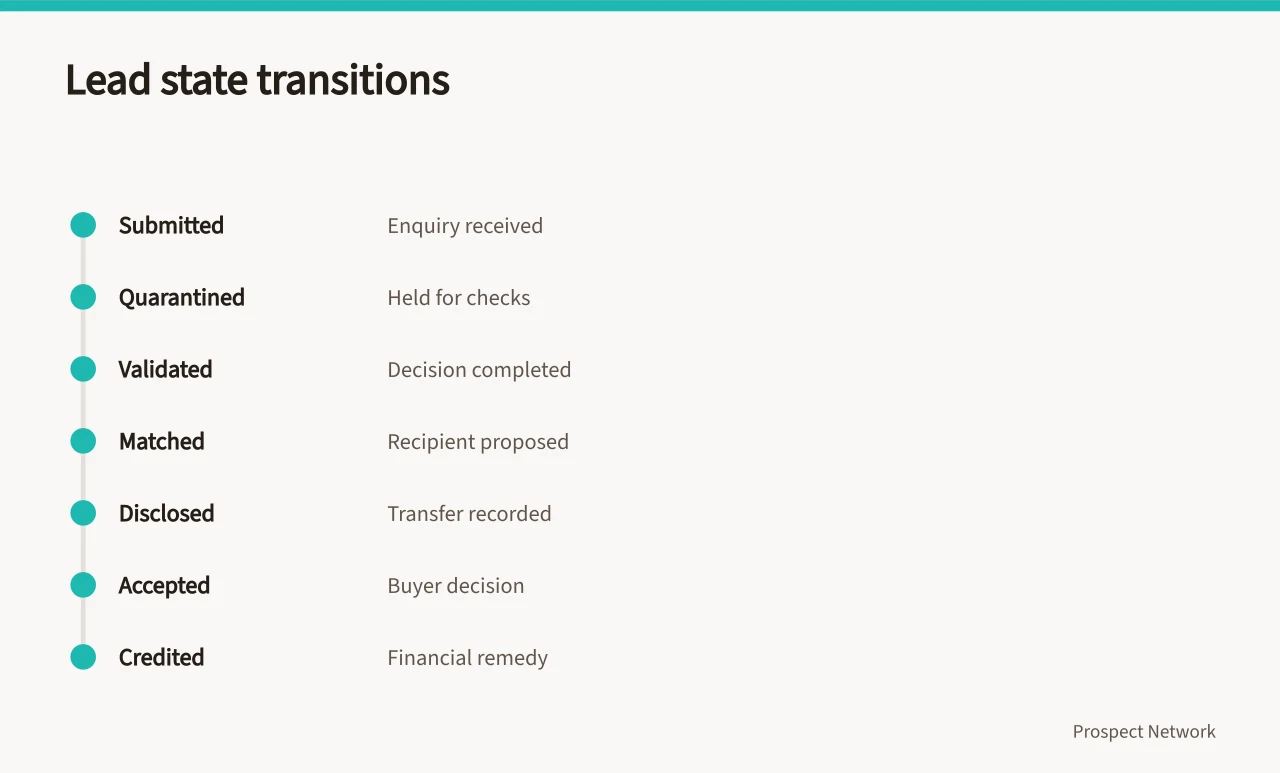
Assign one immutable event identifier and log each transition, rule version, owner and evidence source. Reconcile state counts before calculating ratios. A jump from submitted straight to accepted hides quarantine and disclosure failures.
The ICO's lead collection guidance makes provenance, transparency and buyer checks operational concerns. That supports reporting collection records and objections, not exposing a person's details to every dashboard viewer.
Write a metric contract
Each measure needs the same specification:
Metric contract fields
- purpose and decision supported
- eligible population
- numerator and denominator
- unit and reporting period
- time zone and event-time policy
- inclusion, exclusion and deduplication rules
- owner and independent assurer
- purpose and decision supported;
- numerator and denominator;
- unit and reporting period;
- time zone and event-time policy;
- inclusion, exclusion and deduplication rules;
- source system, table or event and query version;
- owner and independent assurer;
- missing data, uncertainty and known loss;
- threshold source, response and review trigger.
The government AQuA Book is written for government analysis. Its distinction between verification, which checks a specification, and validation, which checks fitness for use, is valuable here. A syntactically correct query can still answer the wrong commercial question.
Define counts before rates
Start with a submitted count based on distinct event IDs received during the reporting period. Quarantined records remain a separate count. Do not call them invalid until the validation state has decided that.
Counts before rates
Count first
- Submitted
- distinct event IDs
- Quarantined
- separate count
- Validated
- completed decisions
- Disclosed
- actual recorded transfer
- Accepted
- buyer decision count
Rate later
- Submitted
- not a share
- Quarantined
- not invalid yet
- Validated
- over eligible closed window
- Disclosed
- not proposed match
- Accepted
- over eligible disclosures
A validation completion measure might be:
validated records / eligible quarantined records whose validation window ended in period
The numerator counts records with a completed validation decision. The denominator excludes items whose approved clock remains open, but must include failed decisions if completed. State the contract window, pauses, time zone, source events and query version. A blank threshold comes from the service owner, not an invented England norm.
Matching coverage can use records with a proposed eligible recipient / validated records eligible for matching. Explain no-match handling and recipient availability. Disclosure count must use actual recorded transfer, not proposed match.
For buyer decisions, show accepted, rejected, disputed and credited counts side by side. An acceptance share is accepted disclosures / eligible disclosures with a completed buyer decision. Credit is a financial remedy, not a data-quality truth, and it should not remove the original state.
Contacted and fulfilled measures require recipient-side events with defined evidence. A phone dial, email send, conversation, appointment and completed service are different outcomes. Never infer fulfilment from acceptance.
Complaint and suppression views need their own populations. Report complaint stage and affected source or recipient using minimum necessary detail. Suppression should show control coverage and unresolved propagation, not publish a list of objectors.
Exit measurement reconciles expected export records, received records, definitions, active queues, access removal and deletion evidence. A completed download is not proof of complete exit.
Show data quality before performance
Every dashboard should surface freshness, missing transition events, duplicate identifiers, late-arriving data, rejected joins, definition version and last successful reconciliation. Put these warnings above performance tiles.
Dashboard quality warnings
- freshness of last refresh
- missing transition events
- duplicate identifiers
- late-arriving data
- rejected joins
- definition version
- last successful reconciliation
Use a blank schema:
View / Required field
- decision
{question and authorised user}- population
{state, geography, dates and eligibility}- formula
{named numerator / named denominator}- data
{system, event, query version and refresh time}- quality
{loss, late data, duplicates and reconciliation}- interpretation
{uncertainty, threshold and response}
No personal name, email, telephone number or free-text enquiry belongs in an aggregate tile. The ICO's data minimisation guidance requires personal information to be adequate, relevant and limited to what the purpose needs. Drill-through access needs a separate role, purpose and audit trail.
Security remains distinct. NCSC guidance on using SaaS securely covers access, activity logging, incident response and continuing review. It does not certify a dashboard or settle privacy permissions.
Keep reporting layers separate
Descriptive monitoring
Descriptive views state what the recorded system shows under a named definition: volumes by state, reconciliation loss, processing time or complaint route. They can reveal a problem but do not explain why it happened.
Rule-based attribution
Attribution assigns credit according to a rule such as first recorded source, last eligible source or a documented multi-touch allocation. Specify window, deduplication, identity resolution, cross-device limits, cross-channel exposure, missing events and refund handling. The output describes the rule. It is not incremental impact.
Causal evaluation
Incrementality asks what would have happened without the network. The HM Treasury Magenta Book addresses government evaluation and distinguishes process, impact and value-for-money work.
Its analytical methods annex discusses experimental and quasi-experimental methods. A private organisation must choose a proportionate method and stop a causal claim when comparison, contamination or measurement assumptions fail.
Editorial planning scenarios
A scenario says what would follow if specified inputs were true. Label the assumptions, source, geography, unit, period and uncertainty. Scenario output is neither observation nor forecast and should never become a benchmark through repeated publication.
Treat revisions honestly
Freeze queries and definitions for each issued report. When later events arrive or methods improve, publish a revision record with old value, new value, reason, affected period and approver. When an error is found, label it as a correction rather than disguising it as routine restatement.
The ONS revisions and correction policy governs official statistics, not private network reporting. Its transparent distinction between revisions and corrections is a useful model for an internal change log.
Apply non-compensating gates
Measurement quality cannot authorise collection, sharing, contact; Privacy and PECR reviewers decide purpose, roles, transparency, objections and channel rules, while security reviewers decide access and incident evidence. Accessibility reviewers verify authorised users and affected people can use reporting and correction paths.
Consumer and advertising reviewers control public claims, while commercial owners reconcile accepted, rejected and credited states. Statistical and evaluation reviewers sign method and uncertainty.
CAP's misleading advertising rules require evidence for objective claims in UK non-broadcast advertising. A dashboard label or supplier case study is not enough to substantiate a broad public claim.
Set thresholds with a response
Record whether a threshold comes from a contract, risk decision, legal deadline or internal operating limit. Never infer one from an incompatible study. For each threshold, name the response, stop condition, recovery evidence and review date.
Examples without values: quarantine if source evidence missing; pause disclosure if wrong-recipient risk appears.
Re-run reconciliation if event loss crosses approved tolerance; hold reporting if query validation fails.
Stop causal language if comparison assumptions break; restrict access after a security signal; retest after an accessibility defect.
Review metric contracts after a new source, recipient, state rule, price unit, channel, purpose, system release, complaint pattern, incident or material data loss. Preserve the earlier contract so trends do not silently combine different definitions.
Before release, an analyst should replay a small authorised fixture set through the query and reconcile expected states to the output. A separate assurer should inspect the metric contract, exclusions, code change and displayed caveat.
Record both checks, the unresolved defects and the report version. Verification confirms that the implementation follows its specification; validation asks whether the resulting view can safely support the stated decision. Neither check supplies a performance conclusion.
The release note should also name the data cut-off, late-event policy and next scheduled review. If a recipient submits corrections after that cut-off, preserve the original publication and issue a controlled revision rather than altering the historical export. Decision-makers need to know whether a difference reflects service behaviour, a newer evidence window or changed calculation code.
Research benchmarks without manufacturing them
Begin with a published source universe and search date. An eligible study must disclose geography, service definition, cohort, period, sample, denominator, method and uncertainty. Check whether England is reported separately. UK or global evidence must retain its geography.
Normalise only when definitions and units genuinely align. Submitted enquiries cannot be pooled with validated records. Buyer acceptance cannot be equated with fulfilled service. Supplier case studies remain attributed promotional evidence unless an independent method supports more.
If no compatible England evidence survives, publish that absence. An internal baseline may still guide improvement when its query, population and limitations are clear. It should be labelled organisational history, not an industry standard.
Good reporting reduces ambiguity before it increases colour. It lets a decision-maker see what changed, whether the data can support that statement, what remains uncertain and which owner must respond.
Before you act
- Keep event times for all named states.
- Assign one immutable event identifier and log transitions.
- Define numerator, denominator and exclusions before rates.
- Surface freshness, duplicates and reconciliation loss above performance.
- Label scenario output as neither observation nor forecast.
- Publish a revision record with old and new values.
Common questions
What should a metric contract specify?
Each measure needs purpose, eligible population, numerator, denominator, unit, reporting period, time zone, inclusion and exclusion rules, source query version, owner, assurer, missing data, uncertainty and threshold source. The AQuA Book distinction between verification and validation matters because a correct query can still answer the wrong commercial question.
Why keep quarantined records as a separate count?
Do not call quarantined records invalid until the validation state has decided that. A jump from submitted straight to accepted hides quarantine and disclosure failures. Reconcile state counts before calculating ratios, and exclude items whose approved validation clock remains open while including completed failed decisions.
How should revisions and corrections be handled?
Freeze queries and definitions for each issued report. When later events arrive or methods improve, publish a revision record with old value, new value, reason, affected period and approver. When an error is found, label it a correction rather than disguising it as routine restatement.
In this guide
- Lead network key metrics: define each rate, show data loss and tie it to actionLead network key metrics for England: counts from submitted to credited, each rate with its numerator and denominator, data loss, PECR consent and TPS checks.
- A lead network dashboard in three bands, with drill-through kept to a minimumLead generation network dashboards need blank metric contracts, state reconciliation, visible freshness, restricted drill-through and decision-led alerts.
- Eight fixtures to test lead network attribution methods before reportingEight authorised fixtures that test a lead network attribution rule before any report, with the expected result recorded first and a pause rule.
- Lead network measurement: correction or revision when a figure changesLead network measurement mistakes need a correction, new data needs a revision. How to tell them apart, label each and republish the affected periods.
- Lead generation networks benchmark research: how to assessLead generation networks benchmark research needs clear definitions, denominators, geography and sources. Learn how to assess comparability.