
Operations
Part of Operating a lead network as explicit states with visible failure queues
Six quality gates for a lead network, from provenance to advertising
Lead generation network quality checks should use observable evidence and separate provenance, privacy, security, accessibility and delivery gates.
This is a pre-release gate review for buyers and operators. Run it before a lead batch, campaign or contract goes live. It applies to subscription networks, marketplaces such as Bark, and managed agencies. Each gate returns pass, fail or unresolved with evidence attached.
What to take away
- Six gates govern releaseprovenance, privacy and PECR, operational quality, security and accessibility, consumer and advertising, and commercial with correction and suppression.
- Every gate answer is observable, marked pass, fail or unresolved, with evidence attached.
- A failed non-compensating gate stops the affected release, and strength elsewhere does not offset it.
- Fulfilling an enquiry does not authorise marketing, because service-request contact and promotion are separate purposes.
- Restart only after the responsible specialist signs off the recovery evidence.
The six gates at a glance
| Gate | Pass test | Minimum evidence |
|---|---|---|
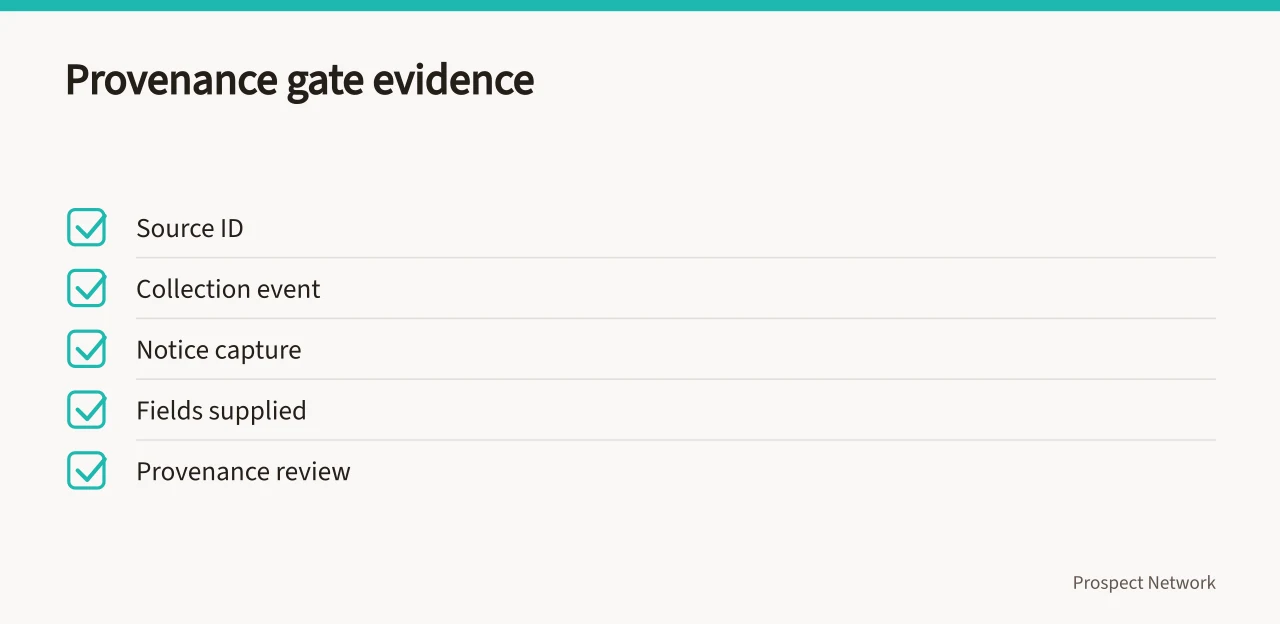
| Provenance | Reviewer reproduces who collected the enquiry, when, by which route, under which notice and for which recipient category | Source ID, collection event, notice capture, fields supplied |
| Privacy and PECR | Purpose, role, lawful basis, recipient and channel rule tie to the real journey | Decision record, role map, objection route |
| Operational quality | Fixtures travel through quarantine, validation, matching, disclosure, acceptance, correction and exit | Fixture catalogue, expected result, actual trace, retest |
| Security and accessibility | Access, logging, incident and deletion controls tested, plus submission, error and complaint paths | Configuration review, access test, assistive-method results |
| Consumer and advertising | Service description, conditions and claims match documented reality | Journey copy, claim file |
| Commercial and correction | Billable units and disputes reconcile, corrections reach every controlled copy, objections block promotion | Signed definitions, reconciled sample, suppression trace |
Provenance gate
Pass: a reviewer can reproduce who collected the enquiry, when, by which route, under which notice and for which disclosed recipient. Fail: the source is described only as public, consented or compliant, or the notice version cannot be recovered.
Example provenance record. Source ID PN-4417; collected 2026-02-03 14:22 GMT via a comparison form. Notice version 4.2 captured 2026-01-28; fields: name, postcode, trade, contact preference. Recipient category: up to three vetted installers.
The ICO's guidance on collecting information and generating leads says buyers must check sources and be transparent when information comes from elsewhere. It does not approve a particular record.
Privacy and PECR gate
Pass: a qualified reviewer ties purpose, role, lawful basis under UK GDPR Article 6, recipient and channel rule to the real journey. A checkbox, contract warranty or existing-customer label is not a substitute.
Privacy and PECR evidence
- Decision record
- Role map
- Disclosure wording
- Objection route
- Channel assessment
The ICO's Direct marketing guidance covers consent and legitimate interests for electronic marketing. A hand-off that fulfils an enquiry cannot by itself authorise a marketing sequence.
Operational quality gate
Pass: synthetic fixtures move through quarantine, validation, matching, disclosure, acceptance, correction and exit with complete state evidence. Missing data inferred, wrong-recipient routing or an unreplayable rejection all fail.
The clock is contract-derived.
Example clock. Event: disclosure to the buyer. Start: 09:00 GMT on disclosure. Pause: while the buyer's CRM is offline. Stop: on acceptance or rejection. Excludes weekends and England bank holidays. Next review: 2026-09-01.
Before signature, recovery and exit testing should follow selecting a lead network with recovery and exit proven.
Security and accessibility gate
Pass: scoped access, logging, incident, recovery and deletion controls carry named evidence and qualified approval. A supplier badge is not an end-to-end test. NCSC's guidance on using software as a service treats secure use as a shared operating task.
Accessibility passes when people can submit, correct information, object and complain through tested paths. Inspecting only the happy-path form fails. The W3C Web Content Accessibility Guidelines 2.2 is the technical standard; a qualified reviewer must address applicable England legal duties separately.
Consumer and advertising gate
Pass: the service description, recipient explanation, material conditions and objective claims match documented reality. Scarcity, quality, savings or availability claims that outrun the evidence fail. Evidence: approved journey copy, claim file, qualification placement and version.
The CAP Code section 3 on misleading advertising requires documentary support for objective claims within its UK remit. Success on one fixture does not substantiate a broad performance claim. For testing a single advert on identity, impression and substantiation, see testing a lead network advert.
Commercial, correction and suppression gate
Pass: billable units, acceptance, rejections, credits, disputes, service change and exit reproduce from both parties' records. A credit that closes an unrelated complaint, privacy issue or security defect fails.
Correction passes when a change reaches every controlled copy. A marketing objection blocks the relevant promotional routes without cancelling an unrelated requested service.
Example suppression trace. Objection logged 2026-03-11 10:04 GMT against source PN-4417; suppression written at 10:09. Three recipient exports re-run at 10:15. Residual-copy check found two rows in the buyer's staging table; both cleared at 11:02. Promotional restart blocked.
How to run the review
- Name the releasebatch, campaign or contract.
- Assign one owner to each of the six gates.
- Attach evidence and mark pass, fail or unresolved.
- Stop the release on any failed non-compensating gate.
- Exercise correction and suppression with authorised fixtures.
- Record the review interval and stop condition.
- Restart only on signed recovery evidence, not a verbal assurance.
Name each gate owner before the review starts. Who owns each gate inside a lead network team maps the decisions, reviews and stop conditions.
Common questions
What does the provenance gate need?
Source ID, collection event, notice capture, fields supplied and a provenance review. A reviewer must reproduce who collected the enquiry, when, by which route, under which notice and for which disclosed recipient.
Why does a fulfilled enquiry not authorise marketing?
Service-request contact and later promotion are separate purposes. The privacy and PECR gate requires a qualified reviewer to tie purpose, role, lawful basis, recipient and channel rule to the real journey before any promotional sequence runs.
What restarts a stopped gate?
A signed recovery record from the responsible specialist. A stopped release must also prove clean correction and suppression, with no unexplained copy and no promotional restart.