

Operations
Part of How to spot low-quality leads from UK lead marketplaces
How to spot low-quality leads from UK lead marketplaces
Fabricated and recycled leads cost UK buyers time and money. A practical checklist for checking phone, address and consent evidence before you pay.
What to take away
- Low-quality leads fall into three groups: fabricated records, recycled records sold twice, and genuine enquiries that sit outside your service area or budget.
- Ask for the supply timestamp on every record, because a delivery timestamp alone hides how long the data has been circulating.
- Run a phone check and a postcode check before you agree the next batch, not after the invoice arrives.
- Treat words such as verified and exclusive as claims to be evidenced, not descriptions to be trusted.
Start with the pattern, not the individual lead
One weak lead proves little. A pattern does.
Take the last 200 leads you bought and group them by arrival time, phone prefix and postcode. Genuine demand follows a working week and a service radius. Fabricated volume tends to arrive overnight, share a few prefixes and carry postcodes well outside the area you agreed.
If two of those three groupings look wrong, the problem sits in the supply route rather than your sales team.
Signals that distinguish fabricated from poor
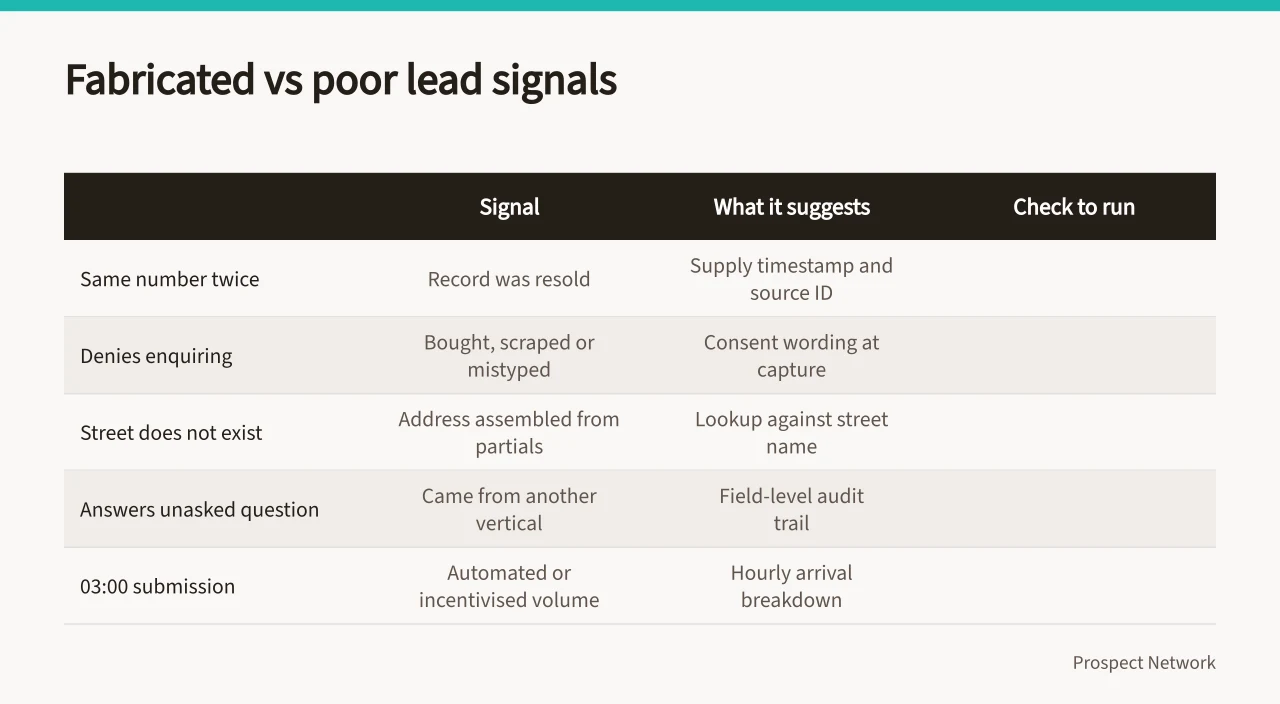
| Signal | What it suggests | Check to run |
|---|---|---|
| Same number twice inside 30 days | The record was resold | Supply timestamp and source ID on both rows |
| Person answers and denies enquiring | Data bought, scraped or mistyped | Consent wording shown at capture |
| Postcode exists, street does not | Address assembled from partial fields | Lookup against the street name |
| Contact answers a question your form never asked | Record came from another vertical | Field-level audit trail |
| Submission at 03:00 for a 09:00 to 17:00 service | Automated or incentivised volume | Hourly arrival breakdown for the batch |
Each signal is weak on its own. Two together justify holding payment and asking for the route the record travelled.
Genuine buyers mistype numbers and move house, so a single failed check proves nothing. Judge the batch, not the row.
A verification checklist for the next batch
Run these six steps on a sample before you commit to volume.
Six-step batch verification
- Pull 100 records, delete rows without timestamp
- Ring each number twice on separate days
- Check postcodes and streets against lookup
- Compare consent wording with collecting brand
- Ask which form, page and campaign produced each
- Work out failure rate and price next order
- Pull 100 records and delete any row without a supply timestamp.
- Ring each number twice, on separate days, and record who answers.
- Check every postcode and street name against a lookup service.
- Compare the consent wording with the brand that collected the data.
- Ask which form, page and campaign produced each record.
- Work out the failure rate and price it into the next order.
Log every outcome with the date and the person who checked it. That log is what you take to the marketplace when you dispute a batch.
Check the lawful basis and the consent wording
Under the UK GDPR, personal data has to be accurate and kept only as long as it is needed. A record with a wrong street name, or consent collected five years ago, fails that test before it reaches your CRM.
Calls and texts need their own permission. The ICO's direct marketing guidance explains what consent has to look like, and a marketplace that cannot show you the exact wording has shown you nothing.
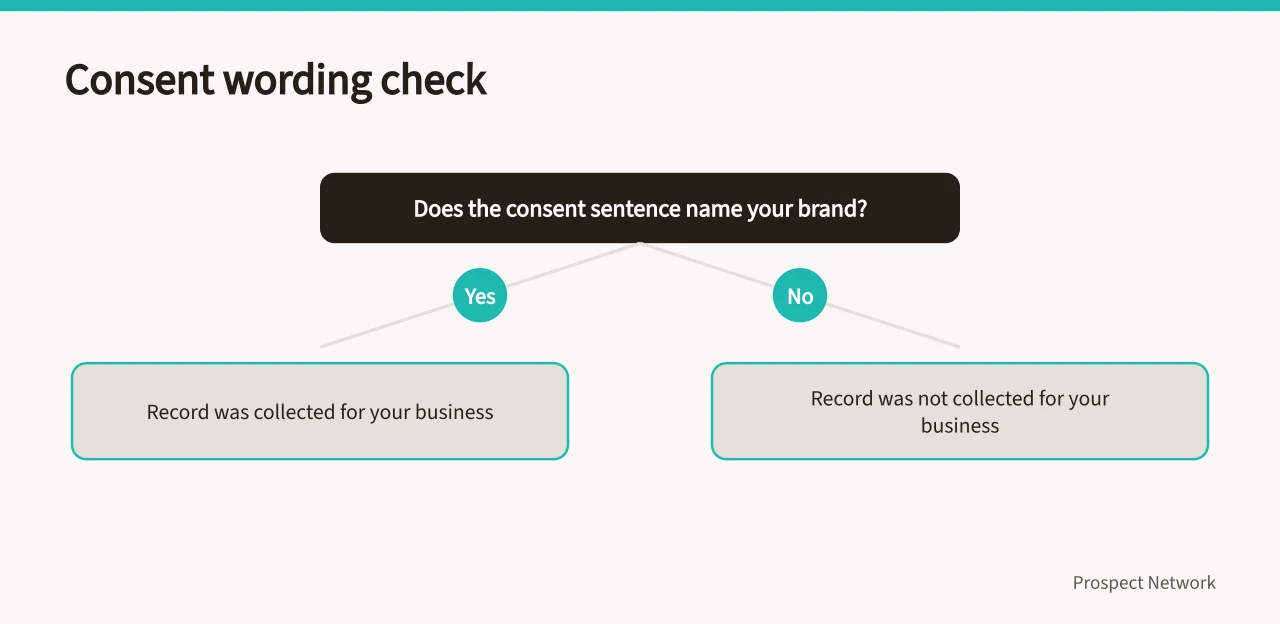
Ask for the sentence the buyer ticked. If it names a different brand, or bundles every partner without naming any, the record was not collected for your business.
Where a network relies on legitimate interests instead, the balancing test has to be documented. Settling the lawful basis for bought leads before you sign is the difference between a defensible list and a liability.
What a verification claim does not cover
A marketplace may describe its leads as verified, and the CAP Code requires that claim to be substantiated with evidence held before publication. Verification usually covers format rather than truth: a working phone number is still a working number if the person never asked for a quote.
Ask what the check covered and when it ran. A number validated at capture can be dead within a month.
Score leads after arrival, not from the seller's summary
Score on evidence you hold: did the person answer, did they confirm the address, did they name the job. A lead that survives three checks is worth calling the same day. One that fails two should be logged and left.
Keep the failed rows, because they are the only record of what you actually paid for. Reconciling them against the invoice turns lead network metrics that expose data loss into a buying decision rather than a complaint.
Common questions
How quickly can a fabricated lead be spotted?
Usually within one call and one postcode lookup. Two minutes of checking costs less than an hour of follow-up.
Does one bad batch mean the marketplace broke the law?
Not automatically. Accuracy and consent failures can breach the UK GDPR, while a lead outside your service area is a commercial problem rather than a regulatory one.
What should a refund clause cover?
It should define a bad lead in measurable terms: no answer on two attempts, an address that fails a lookup, or consent naming another brand. Refunds tied to poor quality alone are hard to enforce.
Should a low score trigger a refund claim or a contract review?
Contract review. A single refund fixes one invoice, while a pattern of failures means the lead specification needs rewriting before you buy again.