

Strategy
Part of A lead network strategy that defines the lead as an inspectable record
A lead network planning template, from lead specification to control log
Use this lead generation networks planning template to record audience, lead quality, permissions, economics, delivery owners and review gates.
This lead generation networks planning template is a blank decision sheet, not a business case. Copy it into the controlled project record and complete every bracketed field with an owner and evidence link. A blank mandatory field means hold.
What to take away
- The same lead definition must appear in the buyer contract, validation queue and management report.
- Service capability does not answer legal questions, so each collection needs a UK GDPR basis and PECR rule.
- The finance director or tax manager signs VAT and accounting treatment, with the VAT return, invoice and ledger extract as evidence.
- The Decision header carries the verdict options and the sign-off list.
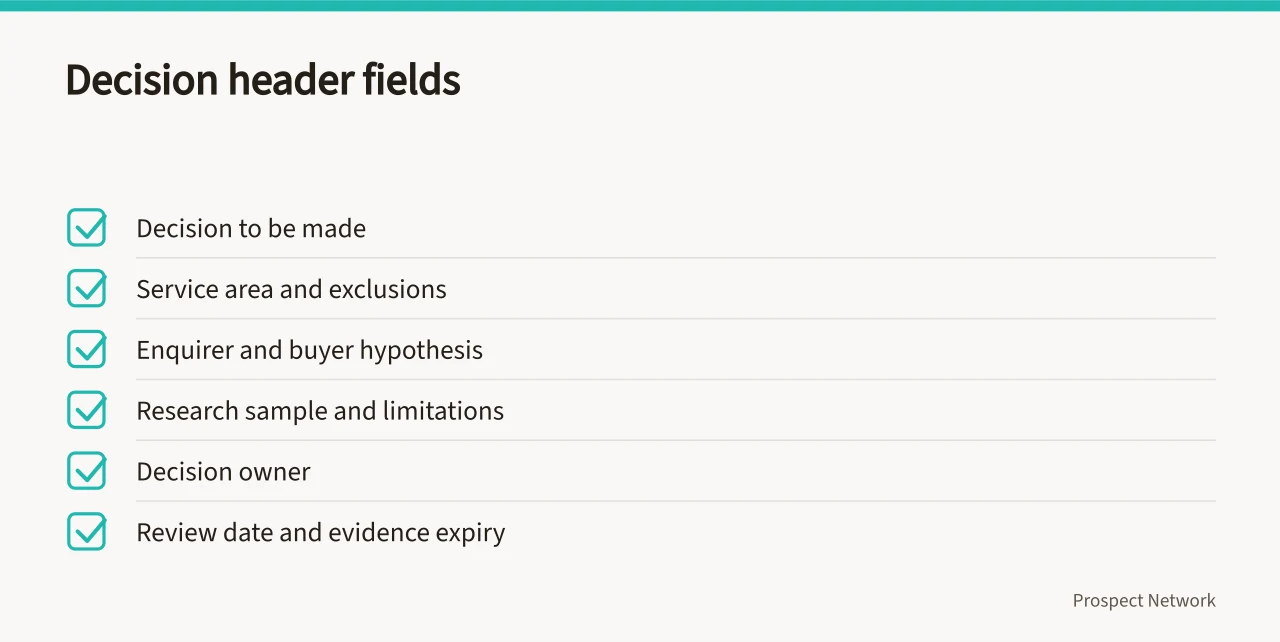
Decision header
- Decision to be made
[ ] - English service area and exclusions
[ ] - Enquirer hypothesis and buyer hypothesis
[ ] - Research completed, sample and limitations
[ ] - Decision owner
[ ] - Review date and evidence expiry
[ ] - Single verdict options
hold [ ] | limited test [ ] | proceed [ ] | stop [ ] - Sign-off list: legal, privacy, PECR, advertising, consumer, competition, finance, tax, security and commercial owners.
- Until all named owners sign their sections, the template remains a draft.
Do not write an England demand estimate from a UK business total. If a public dataset supplies a research frame, retain its unit, coverage, date and geography beside the inference.
Lead specification
- Billable event
[request / released contact / accepted record / other defined event]- Required fields and freshness
[ ]- Validation steps actually performed
[ ]- English location test
[ ]- Recipients and exclusivity
[ ]- Rejection reasons, window and proof
[ ]- Complaint, refund or replacement route
[ ]- Worked example row (illustrative only)
billable eventreleased contact after validation.required fields and freshnessbusiness email, phone, role, company size band, 30 days.validation stepsemail syntax, phone connection, source proof.English location testregistered address in England.recipients and exclusivityone buyer per accepted lead, 30 days.rejection reasons, window and proofinvalid contact, out of area, missing source proof, 14 days, validation log retained.complaint routeemail within 30 days, replacement or credit per contract.
The same definition must appear in the buyer contract, validation queue and management report. Do not use "qualified" without a reproducible test.
Lead specification fields
- Billable event defined
- Required fields and freshness
- Validation steps performed
- English location test
- Recipients and exclusivity
- Rejection reasons, window, proof
- Complaint, refund or replacement route
Data and channel permission sheet
For each collection, disclosure and contact, enter:
Permission sheet per contact
- Purpose, data, source, sender, recipient
- Controller or processor assessment
- UK GDPR lawful basis
- PECR rule for channel
- Notice given at collection
- Objection and suppression recorded
- Retention period set
purpose [ ] | data [ ] | source [ ] | sender [ ] | recipient [ ]
controller/processor assessment [ ] | UK GDPR basis [ ] | PECR rule [ ]
notice [ ] | objection and suppression [ ] | retention [ ]
UK GDPR basis decision list:
- Consentthe individual gave clear affirmative action for this lead use.
- Legitimate interests: a documented balancing test covers the specific lead use.
- Contractthe lead is necessary to deliver a service the individual requested.
- Legal obligationa specific law requires the processing.
PECR rule decision list:
Channel rules
- Live callsscreen against TPS and CTPS, and honour objections.
- Automated callsprior consent required.
- Electronic mailprior consent required, unless the soft opt-in applies to an existing customer.
- Postno PECR consent rule, but UK GDPR still applies.
Service capability does not answer these legal questions. The ICO's lawful-basis guide for direct marketing channels distinguishes live calls, automated calls, electronic mail and post. It is a starting record and is under review; the actual recipient and use need qualified assessment.
When leads will pass to another organisation, save the wording shown at collection and the provenance evidence. ICO guidance on collecting and generating leads explains the transparency and due-diligence issues around buying, renting and sharing marketing information.
Economics ledger
Use pounds and one stated period. The finance director or tax manager signs VAT and accounting treatment, with the VAT return, invoice and ledger extract as evidence.
- Recognised revenue per accepted lead
£[source required] - Less refunds and credits
£[ ] - Less variable acquisition, validation, delivery and support
£[ ] - Contribution per accepted lead:
£[calculated, not guessed] - Fixed cash cost for the period
£[ ] - Internal labour in hours and economic value
[ ] hours | £[ ] - Implementation, migration, assurance and exit costs
£[ ] - Maximum approved exposure and stop authority
£[ ] | [name]
State the numerator and denominator beside every rate. Test sensitivity by changing the uncertain input only; keep other definitions constant.
Add the document, invoice or ledger location that supports each filled value, the checker's name and the expiry date. If finance cannot reconcile a number to the same acceptance unit and period, exclude it from the decision rather than average incompatible observations.
Claims and consumer journey
Create one row in the claims ledger for each objective statement: claim [ ] | audience [ ] | evidence [ ] | date [ ] | qualification [ ] | approver [ ] | expiry [ ].
CAP Code rule 3.7 requires documentary evidence for objective claims before a non-broadcast marketing communication is distributed. Its misleading advertising section also addresses material qualifications. A small-print caveat should not contradict the main message.
For an England consumer journey, record total commitment, delivery, cancellation and complaint information as reviewed. The CMA's current unfair-practices guidance is UK-wide guidance, not a sign-off for the completed form.
Fulfilment and control log
For collection, screening, matching, release, buyer response, rejection, credit, objection, suppression and incident states, enter an owner, input, output, timestamp, service level, retained proof and exception destination. Include accessibility checks on the actual form and complaint route.
The verdict options, approvers, unresolved conditions, rollback route and next date sit in the Decision header.
Before you act
- Copy the template into the controlled project record.
- Fill every bracketed field with an owner and evidence link.
- State the numerator and denominator beside every rate.
- Record the document or ledger location supporting each filled value.
- Add accessibility checks on the actual form and complaint route.
- Get legal, privacy, finance and other owners to sign their sections.
Common questions
What should happen when a mandatory field in the template is left blank?
Hold the decision until the field is filled. The Decision header carries the verdict options for the outcome gate.
How should a UK business total be used for an England demand estimate?
Do not write an England demand estimate from a UK business total. If a public dataset supplies a research frame, retain its unit, coverage, date and geography beside the inference. The lead specification also requires an English location test, and the consumer journey section covers England specifically.
What evidence is needed before making an objective claim in marketing?
CAP Code rule 3.7 requires documentary evidence for objective claims before a non-broadcast marketing communication is distributed. The claims ledger records claim, audience, evidence, date, qualification, approver and expiry. Material qualifications must be addressed, and a small-print caveat should not contradict the main message.