

Tools and providers
Part of How to vet the tools behind lead generation networks
Implementing a lead network tool as a testable state machine
Lead generation networks tool implementation uses controlled states, synthetic acceptance tests, evidence owners, rollback triggers and verified exit rehearsal.
Lead generation networks tool implementation should move through controlled states: design, build, isolated test, restricted pilot and production. Each transition needs evidence from the actual configuration. A supplier guide or successful login is not an acceptance result.
This sequence is for an England-facing enquiry service. Start with synthetic records. Use real personal information only after named reviewers approve the purpose, source, transparency, recipient, channel, security and retention arrangements.
What to take away
- Move lead network tools through design, build, isolated test, restricted pilot and production, requiring evidence at each transition.
- Version every design input and name an owner, so the change board can reject sales-led build requests.
- Give each record one defined state and prohibit silent transitions, with distinct routes for suppressed and disputed records.
- Run acceptance tests by gate, covering operations, privacy, security, accessibility, commercial and exit requirements.
- Limit the pilot by approved sources, buyers, fields, users and duration, and pause it when exceptions occur.
Freeze the design input
Version the journey, data map, field dictionary, buyer list, role assessment, PECR decision, disclosure wording, suppression design and retention schedule. Name an owner for every item. The change board should reject a build request that refers only to a sales demonstration.
The ICO's data protection by design guidance was updated on 5 February 2026. It places privacy work at the start and throughout the lifecycle. That principle does not select the platform or settle the specific legal analysis.
Build a testable state machine
Give each record one defined state and prohibit silent transitions. A submitted enquiry might enter quarantine, pass format checks, wait for an approved match, be disclosed, receive a buyer outcome, then reach retention review. Suppressed, disputed and incident-affected records need distinct routes.
Record states and routes
- Submitted enquiry enters quarantine
- Pass format checks
- Wait for approved match
- Disclosed to buyer
- Receive buyer outcome
- Reach retention review
- Suppressed, disputed, incident routes separate
For every transition, write the permitted actor, required input, resulting output, timestamp, audit event and failure queue. Keep the requested service response separate from later promotion. No automation should create marketing authority that the origin evidence does not contain.
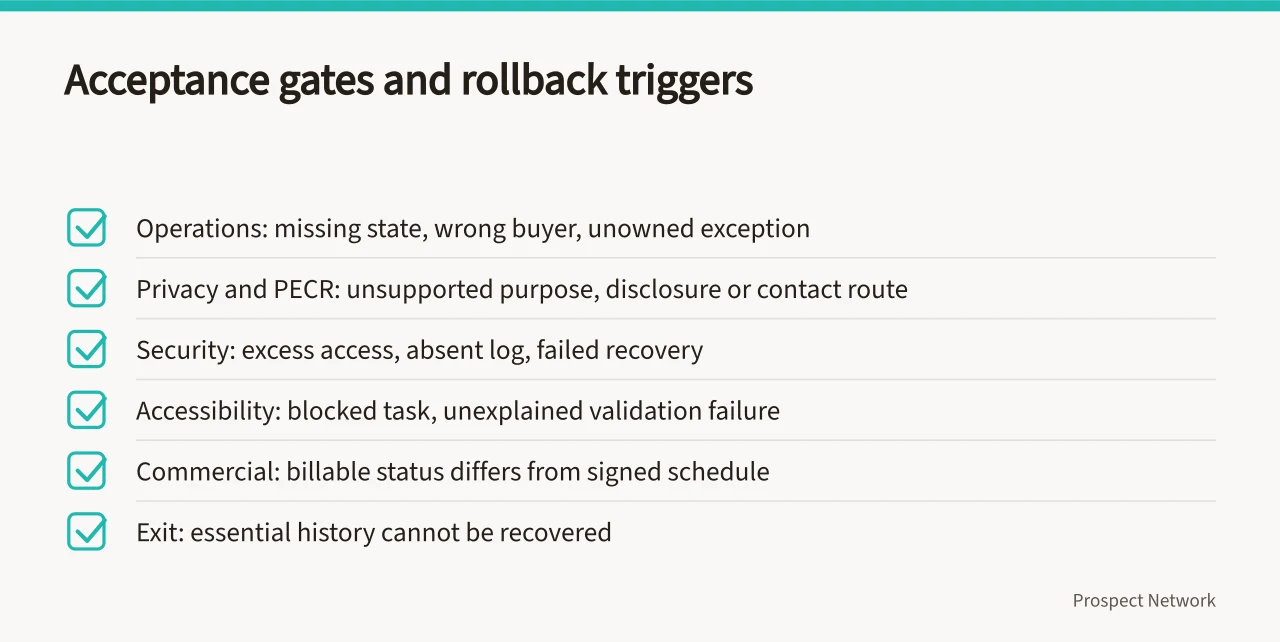
Run acceptance tests by gate
| Gate owner | Test fixture | Stop or rollback trigger |
|---|---|---|
| Operations | valid, duplicate, incomplete and out-of-area requests | missing state, wrong buyer or unowned exception |
| Privacy and PECR | notice versions, recipient sets and channel flags | unsupported purpose, disclosure or contact route |
| Security | least-privilege accounts and agreed audit events | excess access, absent log or failed recovery |
| Accessibility | keyboard, screen-reader, zoom and error paths | blocked task or unexplained validation failure |
| Commercial | accepted and rejected lead definitions | billable status differs from signed schedule |
| Exit | records, links, evidence and suppression export | essential history cannot be recovered |
The NCSC's SaaS security guidance keeps customer configuration responsibilities in view after supplier selection. Apply its access, sharing, monitoring, incident and recovery questions to the purchased tenant. Do not translate a supplier security statement into a passed customer control.
Test the finished public journey against WCAG 2.2. The form component, host page, labels, errors and confirmation work together, so evidence for one piece cannot clear the whole route.
Control the pilot
Limit the pilot by approved sources, named buyers, fields, users and duration. Record every exception. A pilot pauses when an objection does not propagate, a buyer receives an unintended field, the notice differs from the transfer, or the operator cannot reconstruct who did what.
The ICO's preference guidance distinguishes suppression from ordinary audience selection. Test that a suppressed fixture cannot re-enter through import, integration or manual creation, while retaining only the approved minimum identifiers.
Rehearse failure and exit
Disconnect a non-production integration, restore an agreed export and follow the incident route. Confirm who can stop collection, disable a buyer, revoke access and communicate a correction. Compare the exported schema with the field dictionary and account for linked activity, attachments and configuration.
Production approval requires signed evidence from operations, privacy, PECR, security, accessibility, consumer, advertising, commercial and technical owners. Schedule a review after any new source, recipient, purpose, integration or supplier release. Roll back to the last verified state when a change invalidates a gate rather than accepting an undocumented workaround.
Before you act
- Freeze and version the journey, data map, field dictionary and buyer list.
- Define permitted actor, input, output, timestamp and audit event for each transition.
- Test each gate with fixtures and a stop or rollback trigger.
- Limit the pilot by approved sources, buyers, fields, users and duration.
- Rehearse failure and exit, including export, restore and incident routes.
- Obtain signed evidence from all named owners before production approval.
Common questions
When can real personal information be used in the service?
Only after named reviewers approve the purpose, source, transparency, recipient, channel, security and retention arrangements. Start with synthetic records. A supplier guide or successful login is not an acceptance result, so the build must show evidence from the actual configuration before real data enters the journey.
What must be defined for every record transition?
Write the permitted actor, required input, resulting output, timestamp, audit event and failure queue. Each record has one defined state and silent transitions are prohibited. Suppressed, disputed and incident-affected records need distinct routes. Keep the requested service response separate from later promotion, so automation cannot create marketing authority.
What triggers a pause during the restricted pilot?
A pilot pauses when an objection does not propagate, a buyer receives an unintended field, the notice differs from the transfer, or the operator cannot reconstruct who did what. Record every exception. Test that a suppressed fixture cannot re-enter through import, integration or manual creation, while retaining only the approved minimum identifiers.